Residential
Small Living Room Design Ideas That Actually Work
B.I.L.D Team · 7 May 2026
Most small sitting rooms in Kampala homes are not badly sized. They are badly laid out — furniture pushed flat against every wall, a sofa bought for a bigger room, and a walkway that cuts straight through the middle of the seating.
Fixing the layout usually gains more usable space than knocking down a wall.
Fix the Circulation First
Before choosing anything, work out how people move through the room. In most homes there is a route from the door to the corridor, and another to the dining area or kitchen.
Keep those routes at the edge of the room, not through the seating. A sofa arrangement with a walking path running between the seats and the television is not a conversation area — it is a corridor with chairs in it. Moving the seating group so circulation passes behind it is a free improvement.
Leave roughly a comfortable pace of clear width on main routes, and enough space between the sofa and the coffee table to walk without turning sideways.
Scale the Furniture to the Room
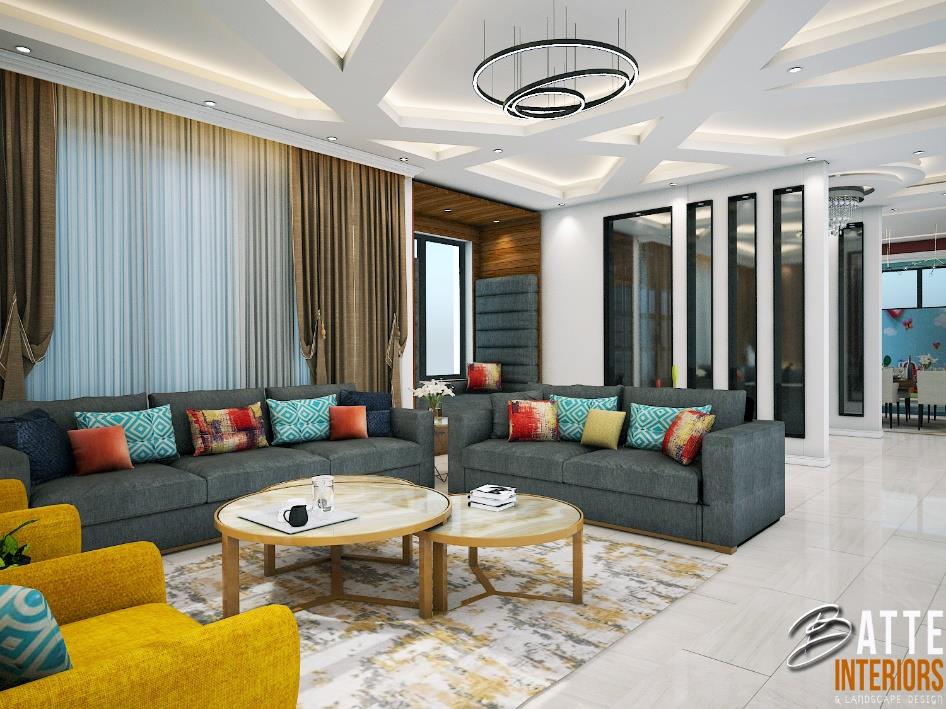
The single most common error is one enormous sofa. A large three-seater plus two chairs will seat fewer people, less comfortably, than a modestly scaled arrangement in the same footprint.
A few things that consistently help:
- Choose seating on legs. Visible floor under furniture makes a room read as larger.
- Keep backs low. Low-backed seating keeps sightlines open across the room.
- Avoid pushing everything to the walls. Pulling seating slightly inward reads as deliberate, not cramped.
- Use one large rug rather than a small one. A rug too small for the seating group visually shrinks the whole arrangement.
Build Storage Into the Walls
Clutter is what makes small rooms feel small. Freestanding storage units eat floor area to solve it, which is self-defeating.
Built-in joinery is the better answer — a full-height unit along one wall, or a TV unit with closed storage below and open display above. It uses the vertical surface you were not using anyway, and because it is made to the wall dimension there are no dead gaps beside it collecting dust.
This is the kind of thing a furniture layout and technical drawing settles before anybody cuts material, so the unit fits the wall exactly rather than approximately.
Layer the Lighting
A single ceiling fixture in the middle of the room flattens everything and pushes the corners into shadow, which makes the room read as smaller than it is.
Three layers fix it: ambient light for general levels, task light where people read or work, and accent light washing a wall or a shelf. Lighting the corners and the vertical surfaces is what makes a small room feel like it has depth. Our lighting and electrical plans set the circuits for this before the ceiling closes, which is the only cheap time to do it.
Use Mirrors With Intent
A mirror opposite a window doubles the daylight and gives the eye somewhere to travel. A mirror facing a blank wall reflects a blank wall.
Place them to reflect something worth reflecting — a window, a view through a doorway, a lit feature wall — and keep them reasonably large. Several small mirrors read as decoration; one generous one reads as architecture.
Colour and Contrast
Light colours do help a small room, but the rule is often misapplied. A room painted entirely one pale colour, floor to ceiling, with pale furniture, has no depth at all.
Keep the base light, then let a single darker element give the eye a reference point — a feature wall, a wood-panelled TV wall, a deep-toned sofa. Contrast is what tells you how far away a surface is, and depth perception is what makes a room feel roomy. There is more on this in our guide to choosing colours for your living room.
Where to Start
If a room feels tight, redraw the layout before you buy anything. A scaled plan will tell you in an afternoon whether the sofa you are considering leaves a walkway or blocks one.
Our space planning service does exactly that, and you can see finished residential concepts in our portfolio. Talk to us if you would like your own room laid out properly.
Related Work
See This In a Real Project

More Reading
Related Articles

Not Sure Which Service You Need?
Start with a consultation — we'll scope the right package for your space and budget.
Request a Consultation